 Modernization advisory for inherited data estates.
 Inventory and scope
Reports, jobs, packages, models, SQL objects, and the estate slice that should be discussed first.
Modernization assessments
A modernization assessment turns partial technical evidence, operating context, and explicit uncertainty into a defensible next decision. For Microsoft BI estates, NextState Data uses a named assessment accelerator alongside consultant review.
What an assessment should produce
The useful outcome is not a tool-generated migration answer. It is a clearer view of what exists, what connects, what remains uncertain, and which decision can responsibly be made next.
Reports, jobs, packages, models, SQL objects, and the estate slice that should be discussed first.
Direct, parsed, and inferred relationships across reporting, orchestration, semantic, and SQL layers, with confidence visible.
Access gaps, unsupported patterns, missing definitions, and unresolved relationships that limit how strongly a finding should be used.
Complexity drivers, warnings, modernization-path inputs, and a clearer basis for roadmap, funding, partner, or platform discussions.
Illustrative product evidence
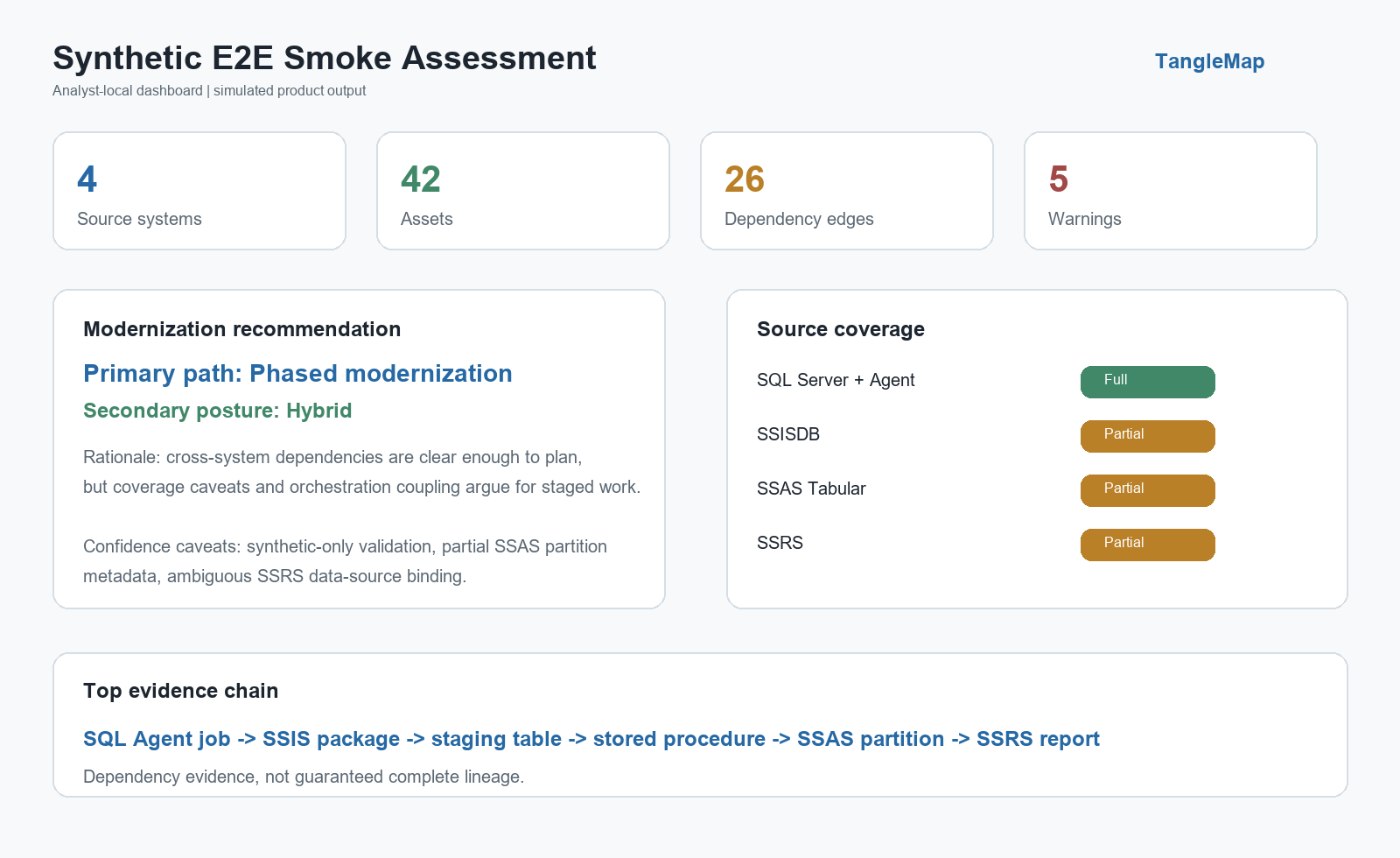
This synthetic TangleMap output shows the intended relationship between inventory, coverage, warnings, recommendation rationale, and dependency evidence.
Named accelerator
TangleMap collects selected metadata and source artifacts from legacy SQL Server, SSRS, SSIS, SSAS, and SQL Agent estates. It produces inventory, dependency evidence, complexity inputs, warnings, and confidence gaps for consultant review.
Durable concept
The public consulting story stays centered on evidence-led assessment. A named accelerator can evolve, be replaced, or gain its own audience without changing the purpose of the engagement or the questions the assessment must answer.
When it fits
It is most useful when the team needs a defensible first view without pretending that a partial scan is complete or that tooling can replace architecture judgment.
Use an assessment when interviews and scattered scripts have not produced a sufficiently shared view of the reporting and data estate.
Select a representative estate slice, define the access model, and agree what evidence would make the assessment useful before collecting broadly.
Assessment tooling can strengthen the evidence. It cannot choose a target platform, guarantee lineage, or replace architecture judgment.
Start here
A short conversation can define the estate slice, the available evidence, the important uncertainties, and the assessment outcome that would be useful.